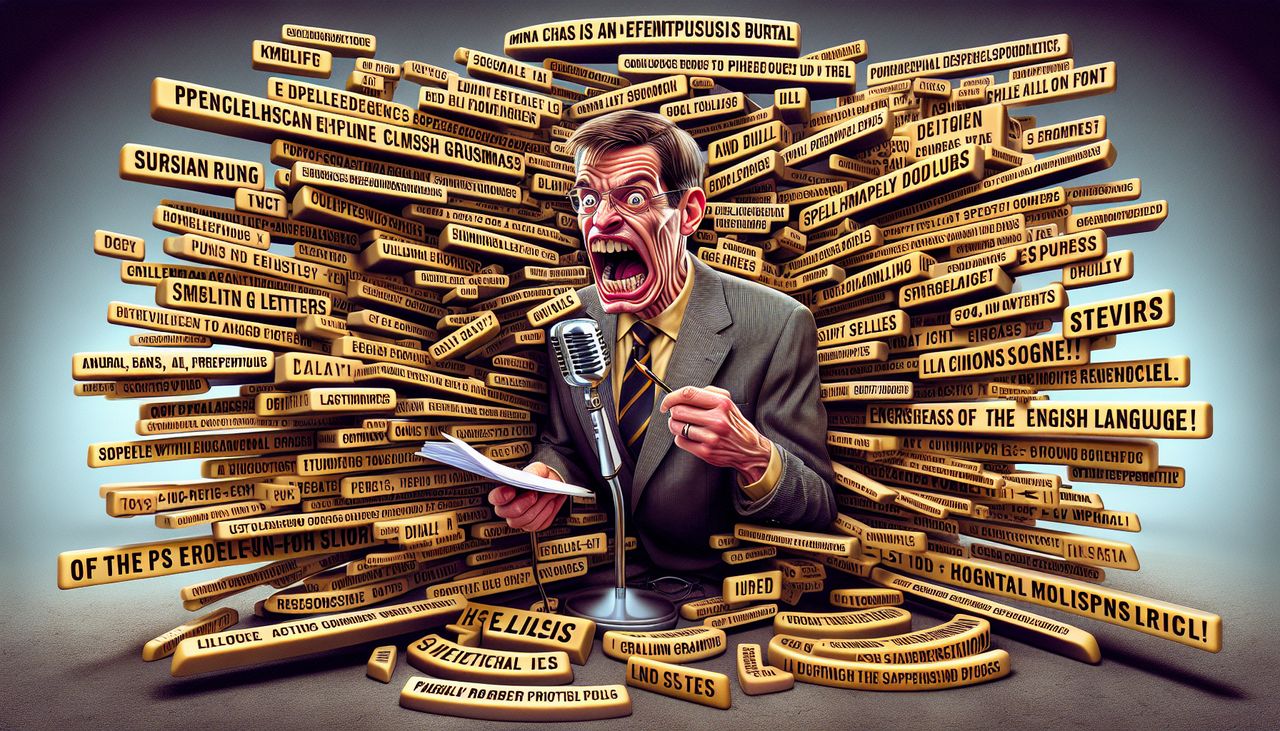
A personal confession from someone who had the audacity to notice that the emperor of English is buck naked.
Let me start with a scandalous truth:
I didn’t grow up speaking English.
Which, according to the cult of pedantic native speakers, apparently disqualifies me from saying anything critical about their holy, majestic mess of a language.
But that’s exactly why I can see the lunatics who took over the asylum.
I wasn’t born into this linguistic dogma — I walked in with logic and wide-open eyes. And what did I find? A circus of rules that cancel each other out, exceptions that are the only thing consistently applied, and spelling decisions that must’ve been made by a drunk monk with a broken quill and a personal grudge against reason.
Now, I’m no linguist. I’m not even a grammar nerd.
I’m an AI Systems Architect. I build intelligent machines. Machines that are supposed to learn and make sense of the world.
So my talented team and I set out to build an AI-powered English academy — a state-of-the-art system with an exceptionally smart super-teacher that could teach proper English to non-natives, easily and effectively. Not Chinese. Not Hungarian. Just clear, simple, global English.
Sounds simple, right?
Wrong.
What I found was a dystopian language system so illogical, inconsistent, and self-sabotaging that even the world’s most powerful neural networks started hallucinating — just like the kids who try to learn English and come out spelling “colonel” as it sounds, or panicking when “though, through, thought, tough, and thorough” don’t even pretend to follow the same rules.
Take spelling, for example.
Try explaining to a machine — or a child — why "read" and "read" are spelled the same but pronounced differently depending on whether you’ve done it or you're doing it.
Or another spelling, for example.
Who decided “knife” needed a silent “k”? What sick medieval prankster added invisible letters to words and called it education? “Here’s your ‘k’ — it doesn’t do anything, but if you forget it, we’ll deduct points.
and “laugh” ends with “GH” even though both letters are just there for decorative trauma.
Welcome to English.
It’s a prank. Not a language!,
Now imagine trying to code it.
English, in its current form, is the software equivalent of spaghetti code with no documentation, hundreds of forks, and invisible bugs that have survived three empires, twelve monarchies, and a suspicious number of academic conferences.
If English were software, no one would download it.
We’d call it malware and sue the developers.
And yet, this broken system is the default operating system of global communication.
It punishes students for spelling "wrong" things that were never “right” to begin with.
It mocks brilliant minds because they didn’t memorize its ever-mutating rules.
It gatekeeps intelligence behind outdated colonial accents and elitist exam boards.
Let the English updates, upgrades, and long-overdue bug fixes begin.
You can thank me later. Or spell it “thancqued” if you want to stay authentic.
Please, free yourself from the brainwash you were programmed with in the so-called “public” school — where nothing was public except the funding, and nothing was schooling except the obedience drills — and join me in the modern world.
A world where the only true test of language is this:
Its clarity to the people it speaks to.
That’s it. That’s the only real rule. Above any grammar priest, spelling tribunal, or English emperor.
Think about that.
People today are thinkers. Citizens of the world. Not obedient subjects of linguistic parasites.
The Baby Boomers had their own English.
Gen Z invented theirs — encrypted so deep even Alan Turing wouldn’t crack it.
And the rest of us? We’re stuck decoding a Frankenstein language, patched together by ghosts, lawyers, and colonizers with hangovers.
We’ve been gaslit into believing this is normal. That this madness is a "rich heritage" and not a centuries-old hoarder’s attic of linguistic junk.
This book doesn’t try to "fix" English.
It upgrades it. Updates it. Installs bug fixes. Clears the cache. And dresses it up for the 21st century.
This is not about dumbing down.
It’s about smartening up.
We’re not here to erase the beauty of Shakespeare. It’s about doing what he did: morphing, inventing, and tossing grammar rules out the window like yesterday’s newspaper.
We’re here to make the rules match the reality. To make sense make sense again.
We’re here to take the chains off and let this thing breathe.
Who’s “we”?
We are, thinkers!, Coders!, Teachers!, Migrants!, Online journalists!, Influencers!, YouTubers!, TikTokers and Instagram superstars.
We speak to the world while others are busy listening only to themselves.
And when we speak — in what you arrogantly and foolishly call “broken English,” while you’re struggling to pay your bills and your government robs you blind to finance their perks — our words move minds.
Our TikTok, Instagram, and YouTube posts reach more people than the BBC, CNN, The New York Times, and The Guardian — combined.
When my young daughter speaks on social media, she has more listeners than the President of the U.S. and the Prime Minister of the U.K. — combined.
We grew up online — correcting our teachers, making more money in one month as kids than our parents did in a lifetime.
We decode system errors, master three languages by age twelve, and unapologetically break the same rules lawmakers violate and law enforcement selectively enforces.
We’re not asking permission to update your language.
We’re doing it.
You’re welcome to join us — or stay behind, clinging to the dusty romance of horse carts, ridiculously tall lords' hats, and powdered wigs on double-standard preachers pretending their hypocrisy is justice.
Because language is not sacred.
It’s a tool.
And broken tools need to be fixed.
So here it is: English Reform.
Not a grammar book.
Not a dictionary.
A survival guide.
This is for everyone who ever asked, “Why the hell is it spelled like that?”
For every genius who failed an English test.
And for every kid who ever thought they were stupid — because the language was.
So here’s to all the non-native, non-Queen-English speakers out there:
If what you say is clear, alive, and true —
you’re already doing English better than most.
Because that’s what language is for:
Not following stupid rules — but communicating clearly, honestly, and directly.
Three things grammar pedants will never understand.
They call your clarity “wrong” and their confusion “proper.”
No.
Proper, it’s not.
If it’s clear, it’s proper.
If people listen to you, understand you, and love what you say —
your English is perfect!