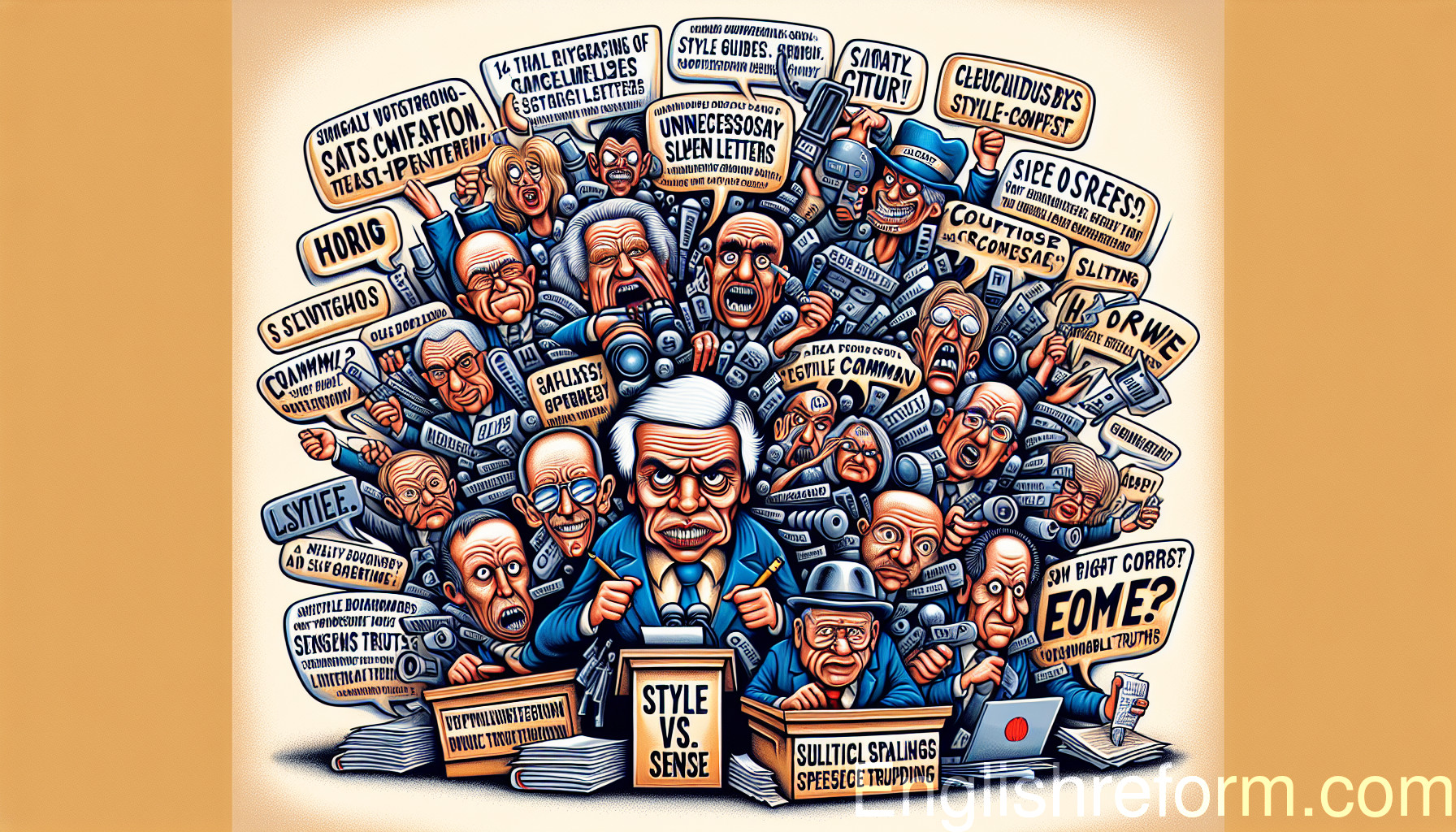
Style guides: because nothing says clarity like six experts disagreeing about the correct comma.
The Traditional Rule:
Good writing follows style guides. Choose Chicago, MLA, APA, Oxford, or AP — and obey. Style equals correctness. Uniformity equals quality. Deviations are mistakes.
Why It’s Broken:
Because style is not grammar — it’s opinion. It’s tradition. It’s a costume party for punctuation and formatting. Every style guide contradicts the others. They argue over commas, quotes, titles, serial commas, and even spelling. What’s “correct” in Chicago is “wrong” in AP. Style is not truth — it’s etiquette dressed up as law.
Absurdities and Contradictions:
-
Oxford comma:
-
“We invited the strippers, JFK, and Stalin.” ← Clear.
-
“We invited the strippers, JFK and Stalin.” ← Different meaning.
-
Yet AP Style says: no Oxford comma. Because… reasons.
-
-
Quotation marks:
-
US: punctuation goes inside quotes. (“Like this.”)
-
UK: punctuation goes outside unless it’s part of the quote. (“Like this”.)
-
-
Capitalization of titles:
-
“The President gave a speech.” vs. “the president spoke at noon.”
-
Who decides if they’re important enough for a capital P?
-
-
Numbers:
-
APA: Spell out one through nine, numerals for 10+.
-
Chicago: Spell out up to one hundred.
-
AP: Just do what feels right today.
-
-
Italics vs. Quotes:
-
Book titles: italics in some guides, quotation marks in others.
-
Foreign words: italicize or don't? Depends who’s judging.
-
-
Sentence spacing:
-
One space after a period or two? This one nearly caused civil war on the internet.
-
Real-World Chaos:
-
Style rules vary by publisher, professor, editor, newspaper, and country.
-
Many job applicants are rejected not for grammar, but for mismatched citation formatting.
-
Writers switch between “rules” depending on where they publish.
-
Microsoft Word autocorrect enforces its own unchangeable preferences.
-
You can lose a grade over a missing serial comma — not a missing idea.
British vs. American Variants:
-
US: “Mr. Smith” and “Dr. Jones.”
-
UK: “Mr Smith” and “Dr Jones” — no period needed.
-
US favors double quotation marks; UK favors single.
-
US: “color,” “analyze,” “organize.”
-
UK: “colour,” “analyse,” “organise.”
-
Neither is more “correct.” Just entrenched.
The Reform Proposal:
-
Stop confusing style with grammar.
-
Recognize that style is context-based, not moral law.
-
Teach style guides as frameworks, not commandments.
-
Encourage clarity and consistency over conformity.
How It Would Work in Practice:
-
Choose a style for a project — stick to it, but don’t punish minor deviations. ✅
-
Acknowledge that the Oxford comma is optional — but useful when clarity is needed. ✅
-
Use quotation and punctuation logically, not dogmatically. ✅
-
Accept both “Mr.” and “Mr” — depending on region and tone. ✅
Final Word: Style Is Not Sacred.
Style guides are helpful, but they’re not holy scripture. What matters is clear, beautiful, effective communication — not whether the semicolon is styled “correctly.” Let’s stop grading people on conformity and start celebrating creativity.