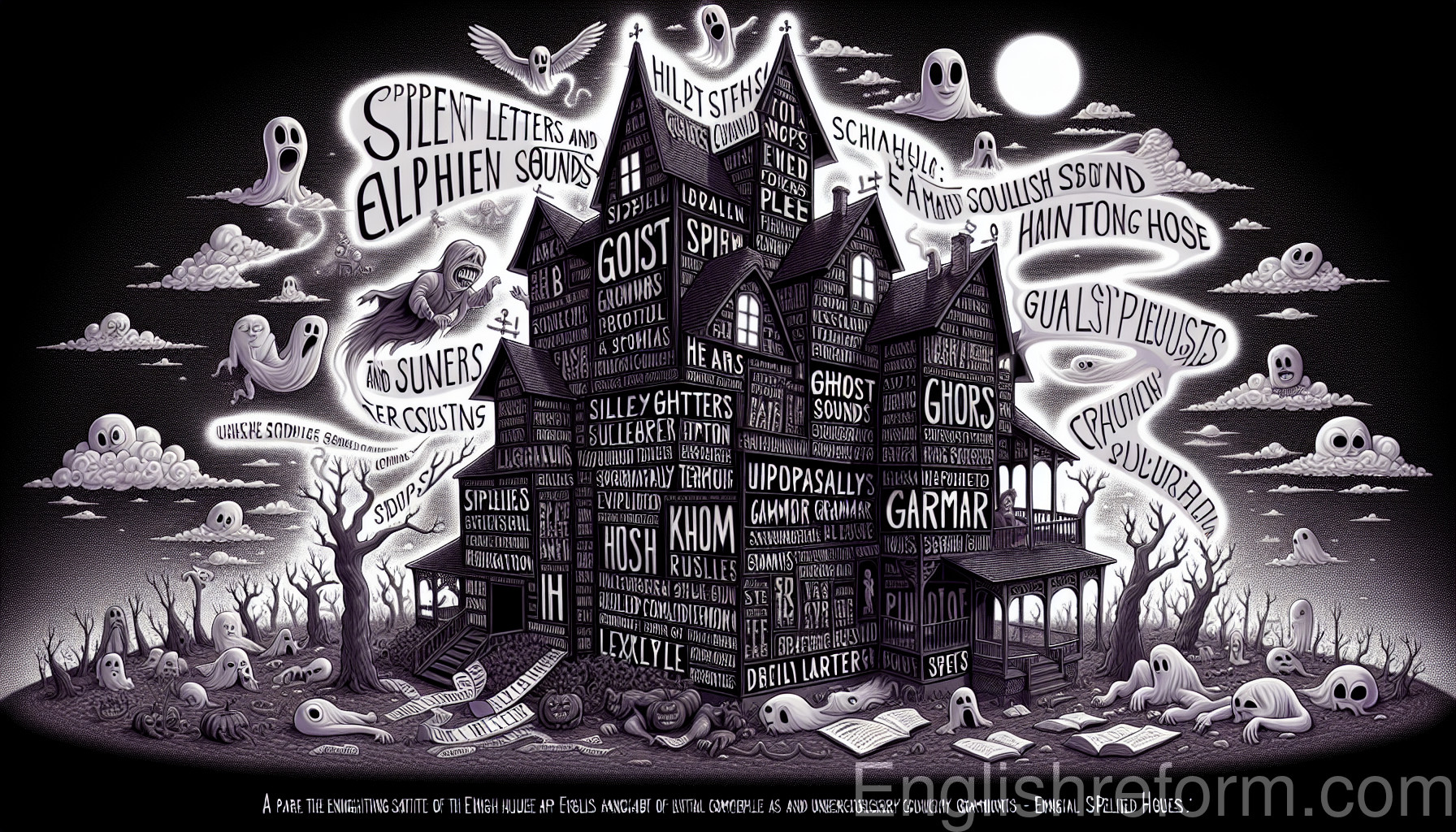
English spelling is a séance — every silent letter is a ghost who refuses to leave.
The Traditional Rule:
Silent letters are a historical legacy. They preserve etymology and show a word’s noble ancestry. They help distinguish homophones in writing and should be memorized.
Why It’s Broken:
Because silent letters are the cobwebs in English’s haunted mansion — spooky remnants from dead languages, stuffed into spellings no one says aloud. They confuse learners, baffle spellers, and serve no functional purpose beyond preserving academic smugness. Why keep letters we never pronounce?
Absurdities and Contradictions:
-
K is the ghost of the front door:
-
Knife, knight, knock, know → All pretend “k” is part of the family. It isn’t.
-
-
W is whispering where it doesn’t belong:
-
Wrist, write, wreck → The “w” silently watches you suffer.
-
-
B haunts like a bad roommate:
-
Dumb, thumb, climb, comb → We say “dum,” “thum,” “clime,” and “come” — but spelling says no.
-
-
G pretends to be helpful:
-
Gnat, gnome, gnash → The “g” is just… hovering.
-
-
L takes silent vacations:
-
Would, should, could, yolk, salmon → You never hear it, yet it’s somehow mandatory.
-
-
T is up to tricks:
-
Listen, castle, whistle → Phantom “t” you never agreed to.
-
-
H is barely hanging on:
-
Hour, honest, heir → Silent “h” creates accent wars (“a historic” vs. “an historic”).
-
Real-World Madness:
-
Children cry over “Wednesday.” (We say “Wensday.” Why spell it like a riddle?)
-
“Subtle” has a “b” only because monks thought it looked more Latin.
-
“Island” was once spelled “iland.” Then someone added an “s” for Latin vibes.
-
“Receipt” added a “p” because French monks wanted it to match “reception.”
-
Silent “gh”? Don’t get us started: laugh, though, through, enough, bough — all pronounced differently.
British vs. American Variants:
-
Americans more readily abandon older silent letters (e.g., “plow” vs. “plough”).
-
Brits often retain archaic spellings for style (“draught,” “pyjamas,” “honour”).
-
Some regional dialects still pronounce certain letters (e.g., Scots saying “loch” with the “ch”).
The Reform Proposal:
-
Phase out silent letters in new teaching materials.
-
Begin public campaigns to normalize phonetic spellings.
-
Accept simplified variants in formal writing (“nite,” “thru,” “enuf”).
-
Create clear dictionaries that flag silent letters and propose logic-based alternatives.
How It Would Work in Practice:
-
Knight → Nite ✅
-
Comb → Come ✅
-
Subtle → Sutl ✅
-
Gnome → Nome ✅
-
Write → Rite ✅
-
Honest → Onest ✅
-
Would → Wood ✅ (But now we need to fix homophones too — see Chapter 10)
Final Word: Exorcise the Alphabet.
Silent letters are linguistic ghosts — decorative, confusing, and culturally exclusive. English doesn’t need haunted spellings to be elegant. Let’s sweep the attic and write the way we speak. No more hiding “k” in the closet.